Total vs. Reverse Shoulder Replacement: What's the Difference?
Medically reviewed by John C. Redfern, MD, Board-Certified Orthopaedic Surgeon.
Total (anatomic) shoulder replacement recreates the shoulder’s natural anatomy and depends on a healthy rotator cuff. Reverse shoulder replacement switches the ball and socket so the deltoid muscle powers the arm instead, which is what makes it so effective when the cuff is torn beyond repair. Both relieve arthritis pain; the right one for you comes down to the condition of your rotator cuff.
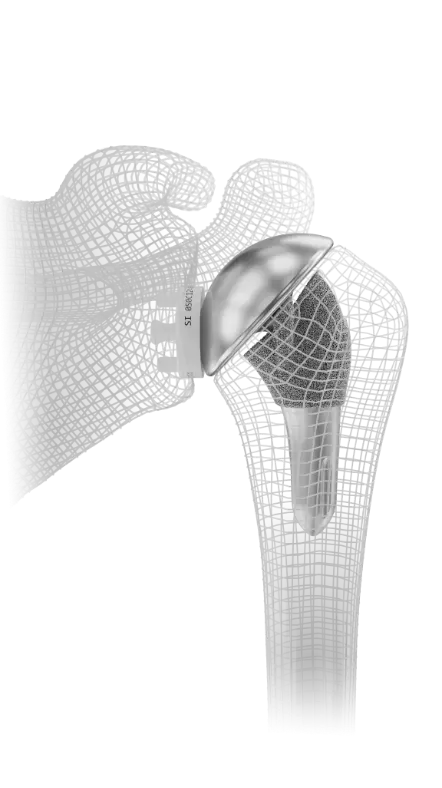
Total (Anatomic) Replacement
Ball on the arm, socket on the shoulder blade, just as nature designed it.
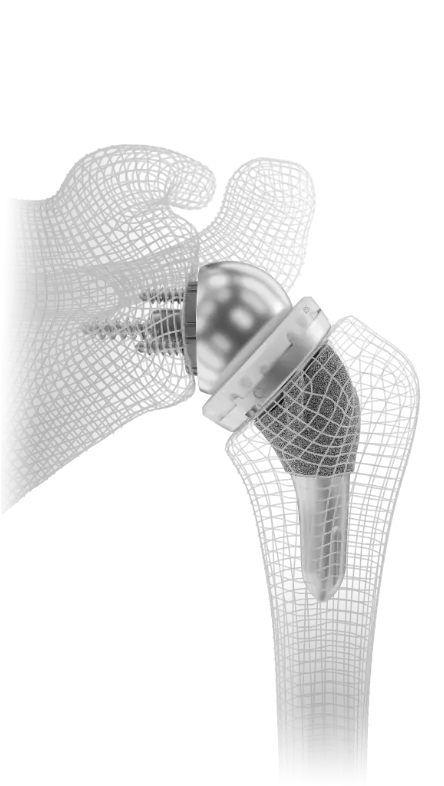
Reverse Replacement
Ball on the shoulder blade, socket on the arm, so the deltoid can lift the arm.
The Deciding Factor Is Your Rotator Cuff
Patients often assume the choice between total and reverse replacement is about severity, as if reverse were the “bigger” operation for worse arthritis. It is not. The choice is almost entirely about the rotator cuff, the group of four tendons that holds the ball centered in the socket and powers the shoulder. If your cuff works, an anatomic total replacement restores the joint you were born with and preserves its most natural mechanics. If your cuff is torn beyond repair, the reverse design exists precisely for that situation and will give you a far better result than an anatomic implant could. This is why the imaging review at your consultation matters so much: the state of your cuff, not the size of your pain, drives the recommendation.
How Each Procedure Works
Anatomic total shoulder replacement. Dr. Redfern replaces the worn humeral head with a polished metal ball and resurfaces the glenoid with a new socket implant, keeping both in their natural positions. Your own rotator cuff continues to center and power the joint, which is why the result feels so natural. With the InSet® system, the socket component is seated within the strongest bone of the glenoid rather than on its surface, and the humeral component can be a short stem or a bone-preserving stemless design. Learn more about total shoulder replacement.
Reverse shoulder replacement. Dr. Redfern places a smooth metal ball on the shoulder blade and a cupped socket on top of the arm bone. Reversing the geometry moves the center of rotation inward and downward, which gives the deltoid the leverage to raise the arm without any help from the rotator cuff. That is what allows a reverse replacement to restore active overhead motion in shoulders that had lost it. Learn more about reverse shoulder replacement.
Side by Side
| Total (Anatomic) | Reverse | |
|---|---|---|
| Best suited for | Advanced shoulder arthritis with a healthy, working rotator cuff | Massive or irreparable cuff tears, cuff tear arthropathy, complex fractures, failed prior surgery |
| Rotator cuff requirement | Requires an intact, functioning cuff | Designed to work without a functioning cuff |
| What is replaced | Ball replaced and socket resurfaced in their natural positions | Ball and socket positions are switched: ball on the shoulder blade, socket on the arm |
| Muscle that powers the arm | Rotator cuff | Deltoid |
| Implant system Dr. Redfern uses | InSet® Total Shoulder System (short-stem or stemless) | InSet® Reverse System |
| Where surgery is done | Often same-day, or one night in the hospital | Often same-day, or one night in the hospital |
| Sling | About four to six weeks | About four to six weeks |
| Typical recovery arc | Daily activities within weeks; strengthening from about six weeks; low-impact recreation around three months | Similar arc; overhead reach often begins returning early once the deltoid takes over |
| Motion you can expect | Aims to restore near-natural mechanics and comfortable motion in all directions | Excellent overhead reach; reaching behind the back typically improves more gradually |
| Track record | Published survivorship above ninety percent at ten years | Documented, lasting improvement in function more than ten years after surgery |
| Special early precautions | Protect the repaired tendon at the front of the shoulder | Avoid reaching behind the back and pushing up from a chair in the first weeks |
This table is general guidance. Dr. Redfern will walk you through exactly what applies to your shoulder.
Which One Is Right for You?
Only an exam and imaging can answer this for certain, but the patterns are consistent. An anatomic total replacement is usually the recommendation when:
- Your main problem is arthritis: stiffness, grinding, and a deep ache, especially at night.
- Your rotator cuff is intact on your MRI and strong on exam.
- You still have reasonable bone in the socket for the implant to seat into.
- You want the most natural-feeling mechanics and the widest range of motion.
A reverse replacement is usually the recommendation when:
- You have a large rotator cuff tear that cannot be repaired, with or without arthritis.
- You cannot actively raise your arm even though it moves freely when someone lifts it for you (pseudoparalysis).
- You have a complex fracture of the upper arm bone, particularly with thinner bone.
- A previous shoulder replacement or cuff repair has not held up.
- Your socket bone is worn in a way that an anatomic implant could not reliably support.
What They Have in Common
The two procedures share far more than they differ. Both relieve the bone-on-bone pain of an arthritic or damaged joint. Both are performed by Dr. Redfern on a same-day or one-night basis for appropriate patients, under general anesthesia with a regional nerve block for comfort. Both use implants from the InSet® family, engineered specifically for the shoulder and designed to preserve your natural bone. Both can be planned in advance on a CT-based three-dimensional model of your shoulder. And both end the same way: a structured recovery with a sling for the early weeks, progressive physical therapy, and a return to the activities that matter to you.
Can a Total Be Converted to a Reverse Later?
Yes, and this is one of the quiet advantages of choosing a bone-preserving implant at the first surgery. If a patient with an anatomic replacement later develops a rotator cuff problem, the InSet® humeral component can often stay in place and be converted to a reverse configuration, rather than requiring the entire implant to be removed. Preserving bone the first time keeps that door open. It is one of the reasons Dr. Redfern selected this system for his patients.
Questions to Ask at Your Consultation
- What is the condition of my rotator cuff, and how does it affect which replacement is right for me?
- Would you show me my imaging and walk me through what you see?
- What motion can I realistically expect to regain, and how soon?
- Which implant will you use, and why?
- Will my surgery be same-day or an overnight stay?
- What are my nonsurgical options, and have we given them a fair chance?
Getting a Clear Answer
If you have been told you need a shoulder replacement and are not sure which kind, or you have received different recommendations from different surgeons, a consultation with Dr. Redfern will give you a clear, plain-language explanation of what your shoulder needs and why. He reviews your imaging with you, explains the reasoning behind his recommendation, and welcomes second-opinion visits. Request an appointment or call (719) 632-7669.
Frequently Asked Questions
Is reverse shoulder replacement better than total?
Neither is better; they solve different problems. Anatomic total replacement is preferred when the rotator cuff is healthy because it restores the most natural mechanics. Reverse replacement is the right choice when the cuff is torn beyond repair, because it is the only design that can restore motion without a working cuff.
Is recovery different between the two?
The overall arc is similar: a sling for the early weeks, therapy, and a return to most activities within about three months. Reverse patients often notice overhead reach improving early, while reaching behind the back takes longer. Anatomic patients follow precautions to protect the repaired tendon at the front of the shoulder.
Can a total shoulder replacement be converted to a reverse later?
In many cases, yes. Bone-preserving implant designs like the InSet® system are intended to make that conversion more straightforward, often leaving the humeral component in place.
Why did my doctor recommend a reverse replacement when I do not have a cuff tear?
There are situations, such as certain fractures or worn socket bone, where a reverse design is more reliable even with an intact cuff. Ask your surgeon to explain the reasoning for your case; Dr. Redfern is happy to provide a second opinion.
Do both procedures use the same implant company?
Yes. Dr. Redfern uses the InSet® Total Shoulder System for anatomic replacement and the InSet® Reverse System for reverse replacement, both from Shoulder Innovations and both built around preserving your natural bone.
Schedule a Consultation with Dr. Redfern
Call the office or request an appointment online and our team will help you take the next step.